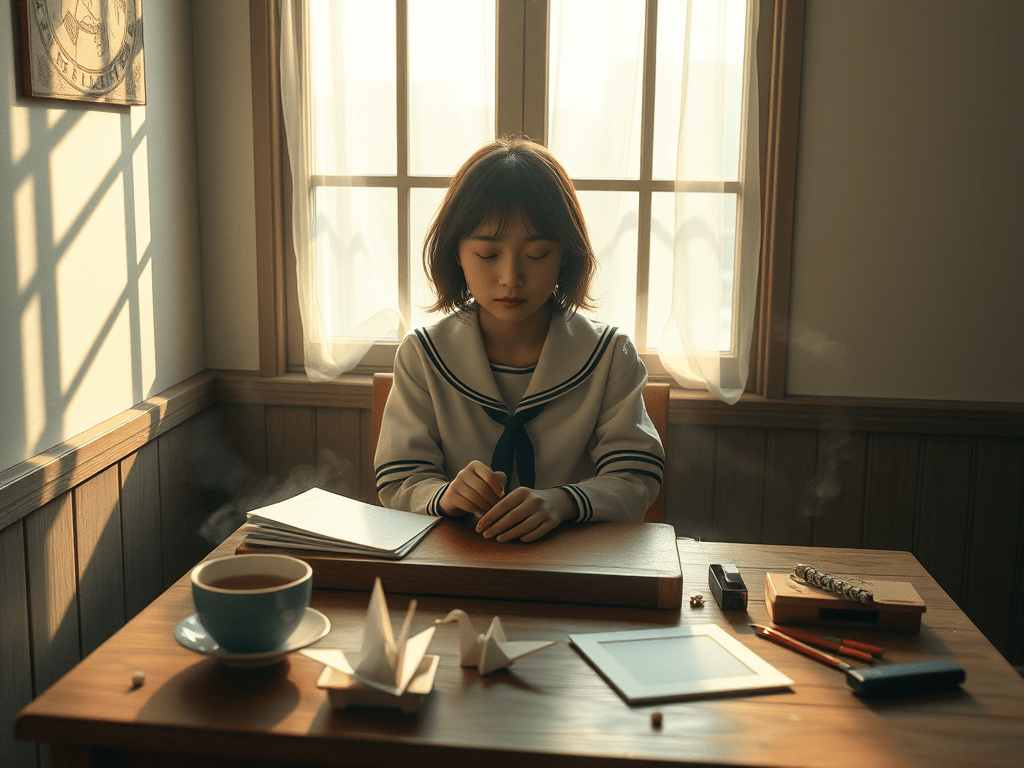
The Cartography of Leaving
You learned to bleed in perfect strokes at fourteen—
a spider-lily bloomed in the margins, sharpening her red pen.
“Too much heart,” she warned, “ruins the form.”
(You folded your pulse into origami birds,
let them nest in the hollow of your ribs.)
Then, a storm in a schoolgirl’s skin—
she laughed like wind chimes in monsoon rain,
her desk etched with secrets, her eyes a dare.
“Meet me after class,” she’d murmur,
her voice a spark in the chalk-dust air.
You traced her name on textbooks,
watched her braid sunlight into her hair.
(She left you a note folded like a crane:
“Someday, we’ll be more than this.”
You still wonder what someday meant.)
A voice dissolved like sugar in rain—
half-sung verses, a hymn swallowed by wind.
“You’ll romanticize this,” the silence sneered.
You built altars from her absence,
lit candles that drowned in their own wax.
(Even ghosts need something to haunt.)
Years later, love arrived as a comma—
a ring glinting like a blade in low light.
“Stay,” she whispered, “but not too close.”
You wrote sonnets in tea-stained ink,
watched steam curl into ghosts above the mug.
Her goodbye tasted of erasers and static:
“Grow up. Write better.”
Now, your girl measures love in decimals:
withdraws like a tide, leaves salt on your tongue.
“What will we become?” you ask.
“Better,” she vows, her breath fogging the window
where you press your palm to the cold glass.
The city stitches itself into your veins—
neon hieroglyphs, wet streets mirroring constellations.
You pack light: three languages, English, Cantonese, Mandarin,
all a compass cracked at true north, and the stubborn arithmetic of hope.
Your apartment hums with the ache of unspoken words,
the fridge buzzing like a trapped fly.
Listen—
the body is not a museum for other people’s ghosts.
What is a name but a cage for borrowed light?
Every soulmate is a season: autumn’s rot,
winter’s sharpened air, spring’s false promise.
You’ve memorized the algebra of leaving—
how distance multiplies, how silence divides.
Who ever taught us to mistake hunger for a home?
Tonight, unfold the map of your scars.
Trace the borders where you ended and others began.
Somewhere, a train screeches. Somewhere, a kettle sings.
You write the next verse with hands that know
how to hold fire, how to let go without flinching—
your voice rising like steam from the pavement,
a new color even the rain can’t wash away.
The Algebra of Silence
We spoke in fractions, you and I—
half-truths stacked like unmarked bills,
our love a flawed equation.
“Solve for X”, you’d say,
tracing circles on my palm,
your touch a variable I couldn’t isolate.
Mornings were proofs left unsolved:
your coffee cup ring on my thesis,
the bed’s empty side a negative space.
“What’s the sum of all we didn’t say?”
I asked the mirror, its glass fogged
with the breath of borrowed time.
You left like a canceled integer,
vanished into the margins of a Monday.
Now, I tally the remainders—
a sweater frayed at the cuff,
a playlist of songs we called ours,
the stubborn logarithm of your name.
Neon Hieroglyphs
The city writes our history in neon—
a motel sign flickering Vacancy,
streetlights pooling like spilled gin.
We kissed beneath a billboard’s glow,
its pixels branding your skin cheap thrills
in a language we pretended not to know.
You were a cipher in a leather jacket,
your laughter a graffiti tag on my ribs.
Stay, I whispered, but the traffic drowned it.
You carved promises into bus-stop benches,
left them to rust in the rain.
Now, I walk these streets alone,
decoding the hieroglyphs you inked in my veins:
a cigarette burn on a love note,
a bruise shaped like a question mark,
the flicker of a 24-Hour Diner sign
still humming your ghost’s favorite song.
The Grammar of Light
You once mistook silence for shelter—
let storms name you “ruin”,
let lovers and strangers script your borders
in vanishing ink.
Now, you parse the world differently:
where they wrote “fracture”, you read “seed”.
Where they left asterisks, you plant verbs.
Your voice, once a question mark,
curls into an exclamation—
a wildfire refusing to apologize for its heat.
See—
you’ve finally learned to conjugate joy:
I am.
I burn.
I begin again.
The dark that once drowned you
is now the soil where you root,
your scars rewoven into wings.
No one owns your lexicon anymore.
The Ride at the Edge of the Map
They call this place the happiest on Earth—
where fireworks bruise the sky with borrowed light,
where carousels spin grief into cotton candy,
sticky-sweet and dissolving on the tongue.
You wore Mickey ears like a crown of thorns,
let a stranger snap your photo mid-laugh,
your smile a currency you didn’t recognize.
Once, you queued for love like a rollercoaster—
hands raised, breath held, heart a reckless cart
clattering toward the drop. This is it, you murmured,
as neon castles loomed, as promises glittered
cheap as plastic gems. But the ride always ended,
left you staggering, dizzy, grasping for a rail
that wasn’t there.
Today, you walk the park at closing time—
confetti swept up, princesses in street clothes,
the teacups stilled to mere ceramic.
A child’s balloon escapes, floats where fireworks failed.
You realize: joy isn’t a place they can ticket,
but the quiet act of untangling your pulse
from the soundtrack.
Look—
your reflection in the Dumbo ride’s chrome:
no longer a ghost clutching a map of someone else’s kingdom.
You’ve outgrown the fairy tales that shrink the world
to a prince, a kiss, a once-upon-a-time.
The real magic? The exit sign glowing steady through the smoke,
your hand—ungloved—reaching for nothing but the air,
finally light enough to hold its own.
Drawing from her experiences as a bisexual female teacher navigating love and loss across borders, Jamie Yung’s poetry bridges the personal and the collective, inviting readers to see their own reflections in her ink, and explores how we outgrow societal scripts to reclaim agency over our narratives.
Discover more from DODGING THE RAIN
Subscribe to get the latest posts sent to your email.
 DODGING THE RAIN